
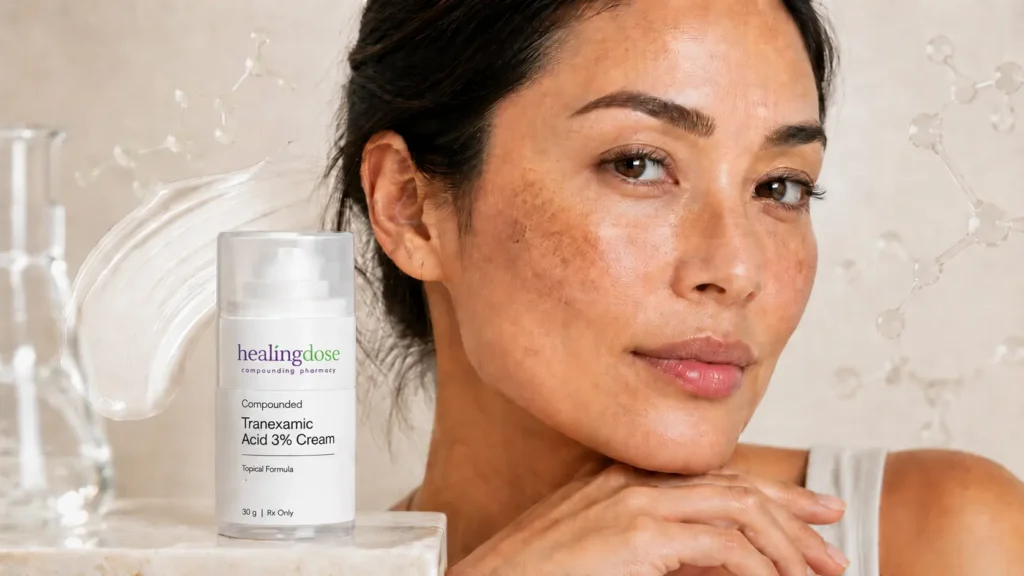
Quick Answer
Researchers have studied topical 3% tranexamic acid (TXA) cream for melasma, including in comparison with 4% hydroquinone. Because prolonged hydroquinone use has been associated with exogenous ochronosis, TXA may be considered as a non-hydroquinone option or during a planned break from hydroquinone. TXA itself hasn’t been shown to prevent ochronosis.
Healing Dose compounds topical TXA, including 3% cream, as well as hydroquinone formulations for individual patients. Topical TXA for melasma is an off-label use.
Ask our pharmacy team about compounded topical TXA and hydroquinone options.

Tranexamic Acid for Melasma: Research on 3% Topical Cream
Melasma can be persistent, and researchers continue to explore topical options such as TXA. This article focuses on 3% topical TXA cream, the research behind it, and how Healing Dose Compounding Pharmacy (HDRx) supports customized dermatology formulations.
What is Compounded Tranexamic Acid Cream?
Compounded topical tranexamic acid is prepared for an individual patient. A prescriber may specify a 3% strength, topical base, or other formulation details to a compounding pharmacy. Topical TXA for melasma is an off-label dermatologic use.
Important Note: Compounded medications are not FDA-approved and do not go through the standard drug approval process. They are prepared for individual patients based on a valid prescription from a licensed practitioner.
What Is Melasma and What Can Contribute to It?
Melasma usually appears as brown or gray-brown patches, often across the cheeks, forehead, nose, or upper lip. While there isn’t one clear cause, several factors are commonly linked to melasma. According to the American Academy of Dermatology, these can include:
- Sun and UV exposure, which can stimulate the skin to produce more melanin
- Hormonal changes, including those that happen during pregnancy
- Certain medications, including oral contraceptives and some medications that increase sun sensitivity
- Family history, since melasma is more common among people who have a blood relative with it
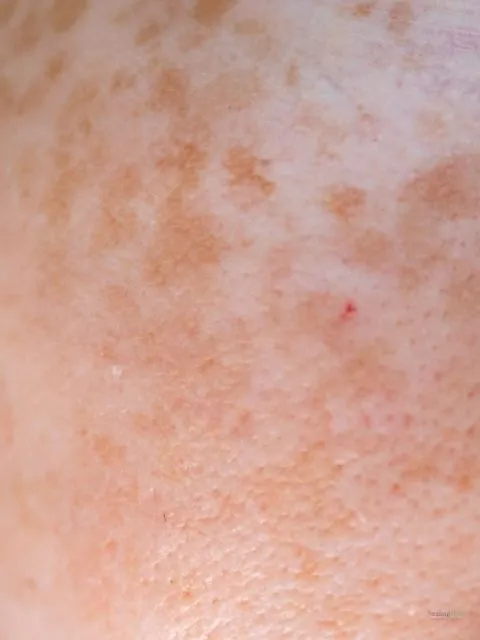
Because melasma can have several contributing factors, a dermatologist or other qualified provider can help evaluate the discoloration and discuss appropriate next steps. Researchers also continue to explore how topical options such as tranexamic acid may relate to pigmentation.
Why Are Researchers Studying Tranexamic Acid for Melasma?
Tranexamic acid (TXA) is an antifibrinolytic medication. It helps keep formed blood clots from breaking down too quickly. One of its established uses is for cyclic heavy menstrual bleeding.
So what does a medication associated with bleeding have to do with melasma?
Interest grew as scientists found that some of the biological pathways influenced by TXA overlap with processes involved in skin pigmentation. A 2024 mechanistic study published in Annals of Dermatology explored this connection using cultured cells, human skin tissue, and a UVB-induced pigmentation model.
The study found that TXA influenced several processes associated with pigmentation, including melanin production, melanocyte activity, and endothelin-1 signaling. These findings help explain why researchers continue to investigate tranexamic acid for melasma and other pigmentation concerns.
What Does Research Say About 3% Topical TXA Cream?
A 2021 randomized clinical study published in Bioscientia Medicina: Journal of Biomedicine and Translational Research compared 3% tranexamic acid cream with 4% hydroquinone in people with epidermal melasma over eight weeks. Of the participants, 30 used a 3% TXA cream, with researchers measuring melasma severity and skin pigmentation along the way.
Looking specifically at the 3% TXA group, the study reported:
- Melasma severity measurements: Researchers recorded lower average modified Melasma Area and Severity Index (mMASI) scores at weeks four and eight compared with baseline.
- Pigmentation measurements: The study also reported a lower average melanin index score in the 3% TXA group by week eight compared with baseline.
A 2025 laboratory study also examined a multi-ingredient topical formulation containing 3% TXA in a UVB-exposed cell model. Researchers reported changes in several pigmentation-related markers, including arachidonic acid, alpha-melanocyte-stimulating hormone (α-MSH), and melanin production. Because the formulation contained multiple ingredients, the findings reflect the formulation as a whole rather than TXA alone.
Where Might TXA Fit Alongside Hydroquinone Use?
Hydroquinone is commonly used for melasma and other pigmentation concerns. However, prolonged use has been associated with exogenous ochronosis, a rare condition that can cause blue-gray or blue-black skin discoloration.
For some patients, topical TXA may be considered as a non-hydroquinone option. A 2024 randomized trial also compared 3% topical TXA with 4% hydroquinone in people with melasma.
Depending on the individual plan, TXA may fit:
- Instead of hydroquinone
- During a planned break from hydroquinone
- As another non-hydroquinone option within a longer-term pigmentation care plan
TXA itself hasn’t been shown to prevent ochronosis. However, using a non-hydroquinone option may provide more flexibility when limiting continuous hydroquinone exposure is a consideration.
HDRx compounds both topical TXA and hydroquinone cream with customizable strengths, bases, and other formulation details.
How Compounding Supports Melasma Care in Michigan
At Healing Dose, our Dermatology Compounding Services provide greater flexibility when a standard commercially made product doesn’t fit a patient’s needs. Our dermatology compounding capabilities include customizations such as:
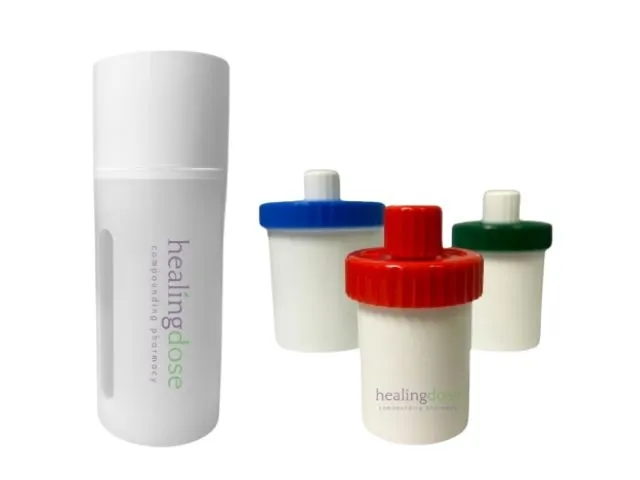
- Dosage forms, including creams, gels, lotions, sprays, and pads
- Medication strengths
- Certain excipients for patients with sensitivities
- Options for certain medications affected by shortages or discontinuation
- Multiple ingredients within a single preparation
These choices can be especially useful with topical medications. The vehicle, strength, and delivery method can shape how the preparation fits into everyday use.
From our Farmington Hills pharmacy, HDRx serves Detroit, Ann Arbor, and communities across Michigan with patient-specific dermatology compounding. We ship statewide in Michigan and to other states where we’re licensed.
What Should You Ask Your Provider About Melasma?
Whether you’ve already been diagnosed with melasma or you’re wondering if the discoloration could be melasma, these are useful questions to bring to your next appointment.
- What might be triggering or making my melasma worse?
- Could topical tranexamic acid be worth considering in my case?
- Would topical TXA make sense instead of hydroquinone or during a planned break from it?
- What should I know about sun protection and my current skin care routine if melasma is a concern?
Talk With Healing Dose About Compounded TXA Prescriptions
When compounded topical TXA is part of your care plan, Healing Dose Compounding Pharmacy can help move the process forward.
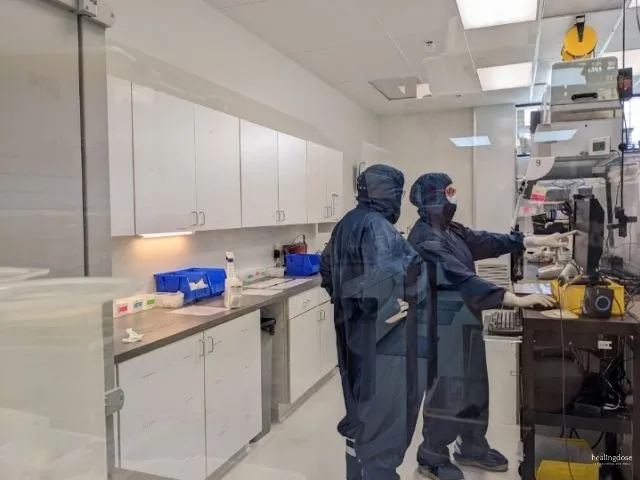
Since 1996, we have specialized in compounding, with accredited sterile and non-sterile services and quality systems independently reviewed against USP compounding standards. We work with patients and clinicians in Michigan, Ohio, and Wisconsin.
For patients, speak with your dermatologist about whether compounding may fit your needs. Once a prescription is sent to us, our pharmacists can answer questions about the compounding process and what to expect next.
For prescribers, Healing Dose offers a Provider Portal for submitting customized prescriptions and coordinating with our compounding team.
Ready to continue the conversation? Connect with an HDRx pharmacist.
Frequently Asked Questions About Compounded TXA Cream for Melasma
What is a compounded 3% topical TXA cream?
It is a customized topical preparation containing tranexamic acid at a 3% strength. The strength, base, and other formulation details can be tailored for the individual patient.
Why are researchers interested in tranexamic acid for skin conditions?
Researchers have explored how TXA may interact with biological pathways involved in melanin production and pigmentation. Tranexamic acid has also been studied in topical applications for melasma, giving researchers another route to explore beyond oral use.
How long was 3% topical TXA cream studied for melasma?
The 2021 clinical study discussed above evaluated 3% topical TXA cream over eight weeks. That study period should not be read as a standard duration for use.
Can a compounded 3% TXA cream contain other ingredients?
Yes. A compounded topical preparation may include more than one ingredient, along with a customized strength, base, or dosage form.
Does compounded topical TXA require a prescription?
Yes. HDRx prepares compounded topical TXA with a valid prescription from a licensed healthcare professional.
References
- Ishack, S., & Lipner, S. R. (2021). Exogenous ochronosis associated with hydroquinone: a systematic review. International Journal of Dermatology, 61(6), 675–684. Link
- Liu, L., Liao, Z., Dong, B., Jiang, S., & Lei, T. (2024). Tranexamic Acid Ameliorates Skin Hyperpigmentation by Downregulating Endothelin-1 Expression in Dermal Microvascular Endothelial Cells. Annals of Dermatology, 36(3), 151. Link
- Marpaung, H. K., Toruan, T. L., Kurniawati, Y., & Theodorus. (2021). Comparison of the effectiveness 3% tranexamic acid cream versus 4% hydroquinone cream for treatment of epidermal type melasma. Bioscientia Medicina Journal of Biomedicine and Translational Research, 5(3), 340–347. Link
- Melasma: Causes. (n.d.). Link
- Ribero, S., Romani, A., Mattozzi, C., & Minoretti, P. (2025b). Comparative Efficacy of Skin-Lightening Formulations in suppressing Ultraviolet B (UVB)-Induced arachidonic acid, Alpha-Melanocyte-Stimulating Hormone (Α-MSH), and melanin expression: an In vitro Keratinocyte-Melanocyte co-culture study. Cureus, 17(2), e78908. Link
- Yasnova, N., Sirait, S. P., & Rahmayunita, G. (2024). The effectiveness and safety of 3% tranexamic acid cream vs. 4% hydroquinone cream for mixed-type melasma in skin of color: a double-blind, split-face, randomized controlled trial. Acta dermatovenerologica Alpina, Pannonica, et Adriatica, 33(2), 83–88. Link